Jarrod Jacobs has preached the gospel for over 25 years, and is currently working with the brethren in Caneyville, KY. He can be reached at jjacobs291@aol.com.
ESTABLISHING BIBLE AUTHORITY
Is the silence of God permissive or prohibitive? If the Word of God says nothing about a given practice, are we allowed to proceed, or does divine silence forbid us from acting?
Many believe that God’s silence grants man permission to act. How often have we heard people ask, “Where does God say not to (fill in the blank)?” Others say, “What’s wrong with (fill in the blank)?”
Believe it or not, this argument has been going on since the days of the early Christians. Tertullian (AD 150-222) wrote that, while some argued, “the thing which is not forbidden is freely permitted,” he responded, “I should rather say that what has not been freely allowed is forbidden” (94). Centuries later, Martin Luther argued with Ulrich Zwingli over the same issue. While it was not his original belief, Luther digressed to the point that he basically said that if a practice is not against Scripture, then it is permitted. Zwingli vehemently denied this, saying that if it is not taught in the New Testament, it should be rejected.
What is the truth concerning the silence of God? Can we act so long as “God doesn’t say not to?” Or, are we prohibited from acting if Sacred Scripture is silent? The answer is found in His Word.
In Human Affairs
Let us acknowledge that in the affairs and activities of men, silence is considered restrictive. When we order something from Amazon.com, we specify exactly what we want. If we do not receive exactly what we ordered, would not an email or a phone call be made to the company, saying that someone messed up the order? Of course! Why? Because we placed a specific order, and that order was not fulfilled; we expect to receive what we ordered. Our “silence” restricted the order to only what we specified. In other words, when ordering something, we do not send the order and also an additional note telling the company all the things we do not want! Yes, even with men, silence is restrictive.
On the job, we often follow specific rules. Some jobs require employees to wear a hard hat. How long would a person be employed if they flaunted this rule? Would someone be able to convince the employer that wearing a paper hat was O.K.? Could he successfully argue, “You didn’t say not to do that”? If a hard hat is required on the job, the employer simply has to specify this fact. He didn’t have to include an additional list of all the hats you cannot wear while working.
If we recognize that man’s silence is restrictive, why do we have such a hard time understanding that the same is true of the Bible? God made us in His image, providing us with intelligence and reasoning capabilities (Gen. 1:26-27; James 3:9). God’s Word is clear: silence is restrictive.
In the Old Testament
As Moses led the children of Israel out of Egyptian bondage, they soon reached the Red Sea, a barrier that prohibited further movement. With the army of Pharaoh advancing, the people were afraid. Moses said, “Fear ye not, stand still, and see the salvation of the Lord, which he will shew to you today: for the Egyptians whom ye have seen to day, ye shall see them again no more forever. The Lord shall fight for you, and ye shall hold your peace” (Exod. 14:13-14).
Afterwards, the Lord parted the waters, and the Israelites crossed over on dry ground (vv. 15-16); however, at this point, the people had not heard that command. Since God had not spoken at this time about what they were to do at the Red Sea, Moses commanded the people to stand still. They were not to act until God had spoken to them. Divine silence did not permit them to swim ahead, dig a tunnel, go around the Red Sea, or anything else. Moses did not say, “God didn’t tell us not to swim across the Red Sea, so let’s go.” Until God spoke to Moses, they stood still!
Read Numbers 9:2-11. The nation of Israel was to observe the Passover. However, two came and said they were unclean, because they had been defiled by touching a dead man’s body. They asked what to do. What did Moses say? Did he just assume they could keep the Passover? Did he tell them to wait until next year? No, he said, “Stand still, and I will hear what the Lord will command concerning you” (Num. 9:8). Once he inquired of the Lord, the matter was resolved (Num. 9:9-14). Let us learn this vital lesson: when God is silent, we must stand still! God’s silence is intended to stop us from acting; it is not permission to do as we please.
Note the difference between doing what God has authorized versus what He has not. Deuteronomy 28:1-14 makes an excellent case for respecting God’s silence. The Lord promised to bless those who were obedient to Him. The New Testament provides the same assurance (Matt. 7:21; Rev. 22:14; etc.). In Deuteronomy 28:15-68, we read of curse after curse that would come upon Israel if they acted when God was silent. Why was such conduct wrong? Because “the secret things belong unto the Lord our God: but those things which are revealed belong unto us and to our children for ever, that we may do all the words of this law” (Deut. 29:29).
God has revealed all that we need in order to live acceptable and enjoyable lives (2 Tim. 3:16-17; 2 Pet. 1:3). Therefore, why would we want to act when God is silent? This type thinking opens the door to sin and error. Sadly, while some argue about God’s silence, there are a great many who have not come to terms with what God has said (Mark 16:16).
In the New Testament
Just as the Old Testament teaches that man cannot act when God is silent, the New Testament affirms the same thing. For instance, we know that no angel could be God’s Son (despite what Jehovah’s Witnesses and others might say). How so? Because the Hebrew writer says,
“But unto the Son he saith, Thy throne, O God, is for ever and ever: a sceptre of righteousness is the sceptre of thy kingdom. Thou hast loved righteousness, and hated iniquity; therefore God, even thy God, hath anointed thee with the oil of gladness above thy fellows. And, Thou, Lord, in the beginning hast laid the foundation of the earth; and the heavens are the works of thine hands: They shall perish; but thou remainest; and they all shall wax old as doth a garment; And as a vesture shalt thou fold them up, and they shall be changed: but thou art the same, and thy years shall not fail. But to which of the angels said he at any time, Sit on my right hand, until I make thine enemies thy footstool? Are they not all ministering spirits, sent forth to minister for them who shall be heirs of salvation?” (Heb. 1:8-14).
No angel could be counted as God’s Son, because God only said these things to His Son! He didn’t say these things to Christ and then state, “Now, I am not talking about any angelic beings.” God was silent in saying these things to angels. Thus, they were restricted from being counted as God’s firstborn, having a scepter, or having a kingdom. It was not because God specifically told the angels “No,” but because He was silent toward them in this matter. God’s silence restricts!
In Hebrews 7:12-14, we learn that without a change of the law, Christ could not be a priest. Why? “For it is evident that our Lord sprang out of Juda; of which tribe Moses spake nothing concerning priesthood.” Moreover, God specified the Levitical tribe as the priestly tribe (Num. 18:1-24). He did not have to list all the other tribes and say, “Not you!” By divine silence, the other tribes were restricted/prohibited from being priests. Since God was silent about authorizing priests from the tribe of Judah, the Hebrew writer states that Christ could not be a priest while on earth. For this to occur, a change in the law was demanded. Therefore, the law has changed, and we today are under the New Testament (Covenant), and not the Old; Jesus Christ is a “high priest forever after the order of Melchizedek” (Heb. 5:10; 6:20; 7:17, 21).
Finally, when the Jews disputed over whether Gentiles could be saved without physical circumcision, it was God’s silence that settled the matter once and for all (Acts 15:7-15, 24). Throughout the Scriptures, God’s silence clearly prohibits unauthorized action on man’s part. Shame on anyone who says otherwise.
Conclusion
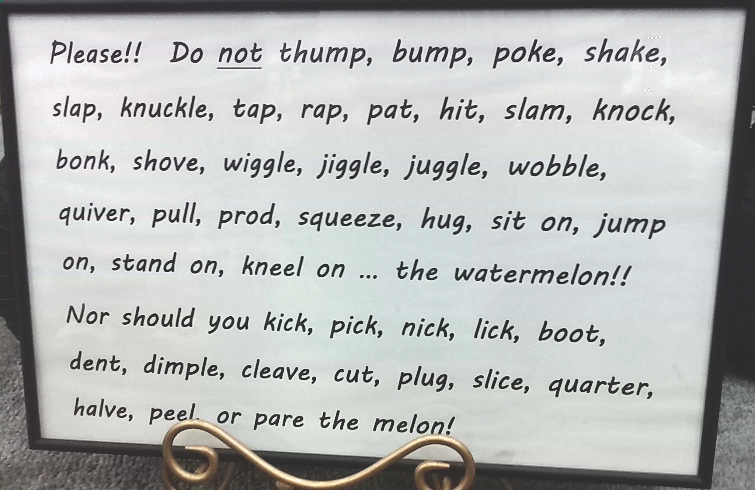
I am reminded of a sign I have frequently seen at the Kentucky State Fair that is placed in front of a certain large watermelon. I get the sign’s humor—it is makes a good point; yet, I wonder, why did someone think that a sign saying, “Don’t Touch This Watermelon!” was insufficient? Perhaps, through the years, the melon’s owners had to deal with those who said, “You didn’t say not to do this or that….” and thus was born a sign listing forty-two possible but prohibited ways that one might contact a watermelon. Yet, “Don’t Touch It!” would have sufficed.
This demonstrates the spiritual lesson under consideration: silence prohibits and restricts. If such were not the case, God would not only need to tell us what to do, but also must tell us all the countless things we are not to do. Had He taken this approach, the Bible would be so large and heavy that we would be unable to pick it up! Talk about some tedious reading! Thank God for His wisdom. Be grateful for the gifts of reason and logic. Recognize the truth that God’s silence restricts or prohibits our actions.
Source
Tertullian. “The Chaplet, or De Corona.” Latin Christianity: Its Founder, Tertullian. Edited by Alexander Roberts, James Donaldson, and A. Cleveland Coxe. The Ante-Nicene Fathers. Vol. 3. Buffalo, NY: Christian Literature Company, 1885.